
Make it So: our weekend at NASA Space Apps 2026
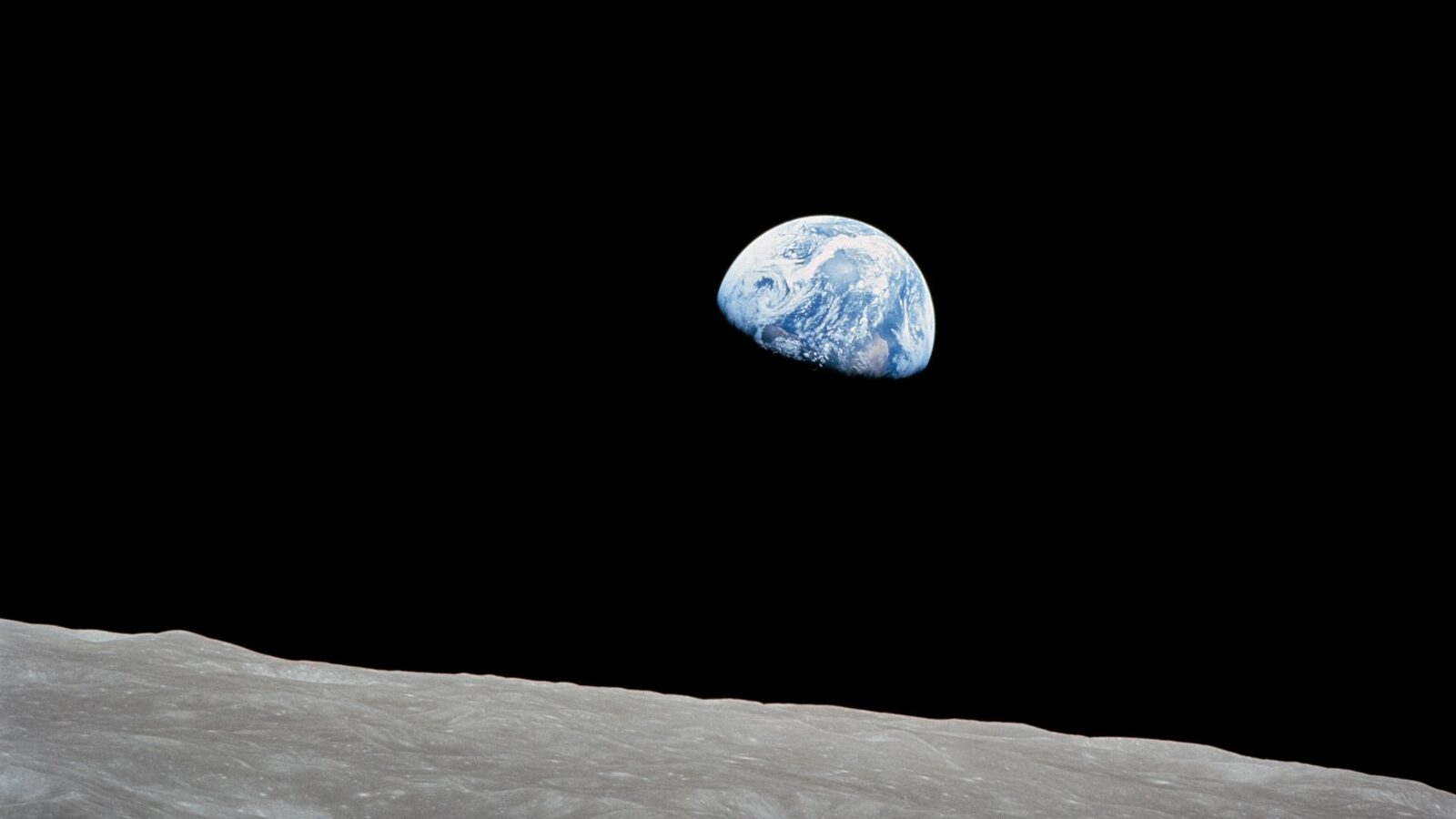
Matt from the Refactor Red team and I spent the weekend of 14 and 15 November building a Moon landing tool for the NASA Space Apps Challenge. It was the most fun I have had writing code in ages.
Space has been a passion of mine since I was a kid, and a hackathon is the perfect way to dive in: one hard problem, a fixed deadline, and a weekend to see how far we can push what we build.
The challenge: which landing site still works?
We entered as a two-person team, Make it So, and picked the Lunar Landing Site Navigator challenge. Our answer is Four Lights, a free web tool that answers one question for the Moon's south pole, where NASA's Artemis crews are headed: which landing site still works when your launch slips?
For a site and a landing date it checks four lights against the real terrain horizon:
- Sun: is the Sun above the skyline?
- Power: does the lander get enough sunlight to keep its batteries alive through the window?
- Earth: is Earth above the skyline?
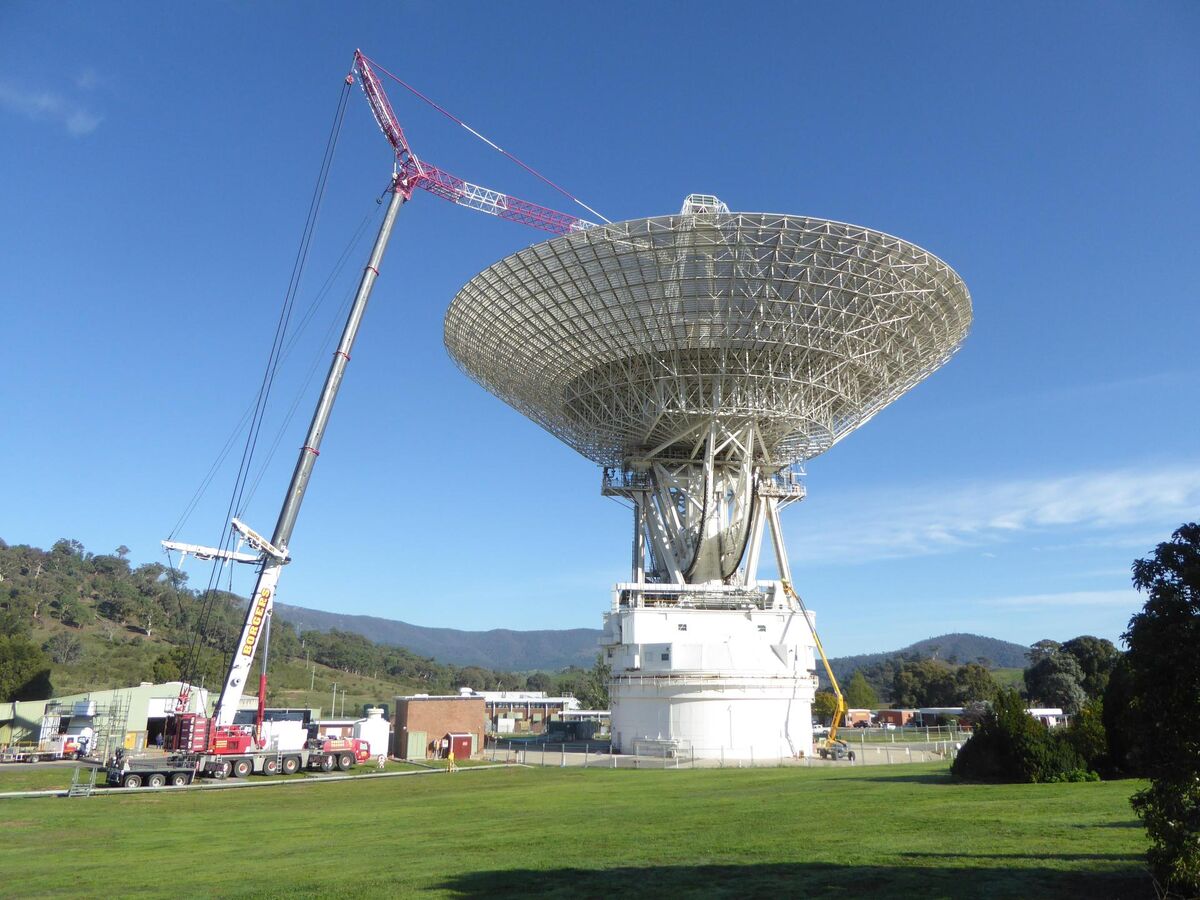
- Comms: can a Deep Space Network dish see the Moon at the same time?
The Slip Planner then shows how many usable days each of 12 candidate sites gets, and what a slip of a day or a week costs you.
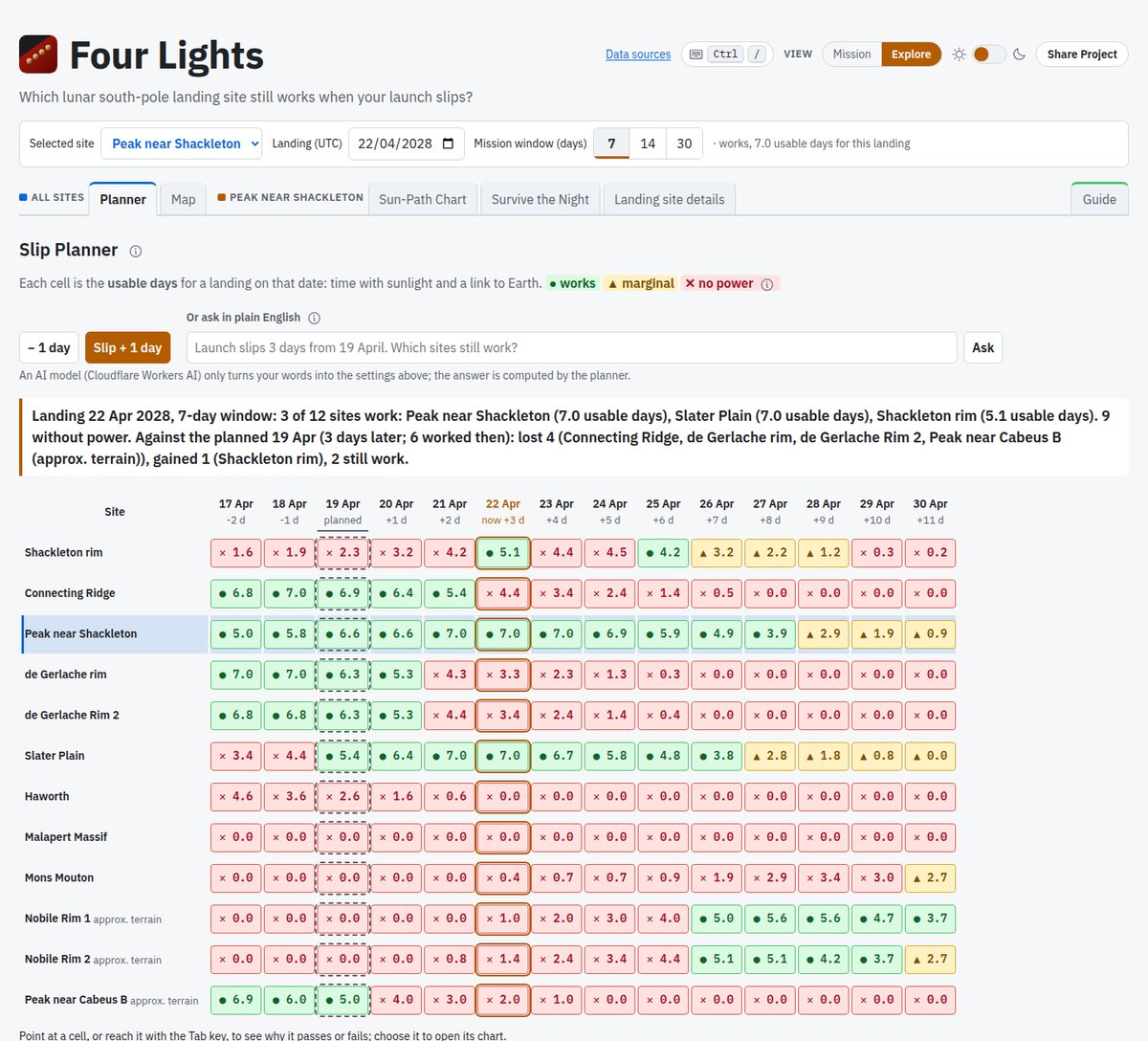
Make it So
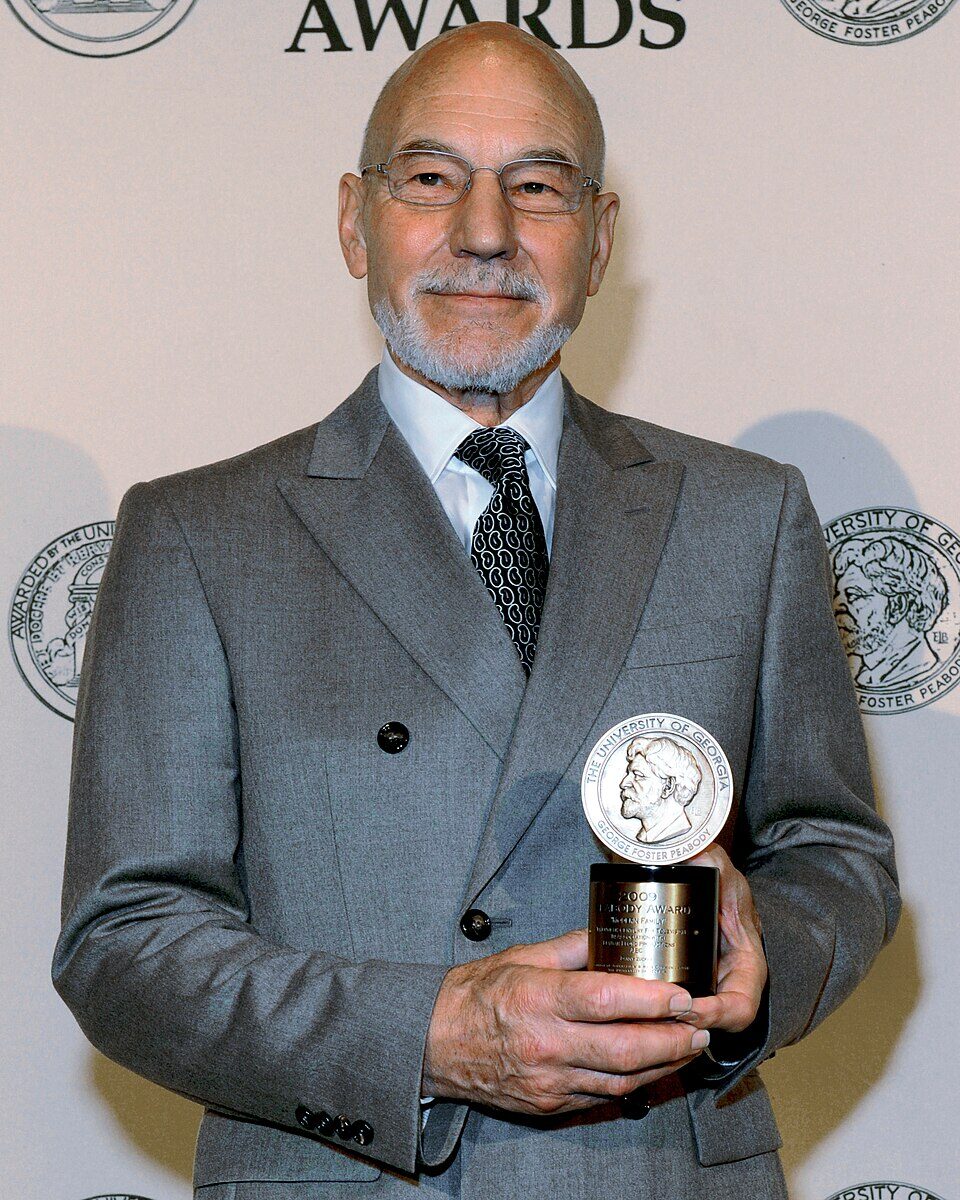
"Make it so" is Captain Jean-Luc Picard's order on Star Trek: The Next Generation: decide what needs doing, then get it done. That is roughly how two developers get a working Moon tool out of one weekend. Our team logo is four gold pips on a red collar, Picard's captain's rank, and anyone who knows the episode Chain of Command will hear "there are four lights" in the product name.
Sir Patrick Stewart, who gave Picard his voice, died in late October aged 86, a couple of weeks before the hackathon. Vale, Sir Patrick.
How it works
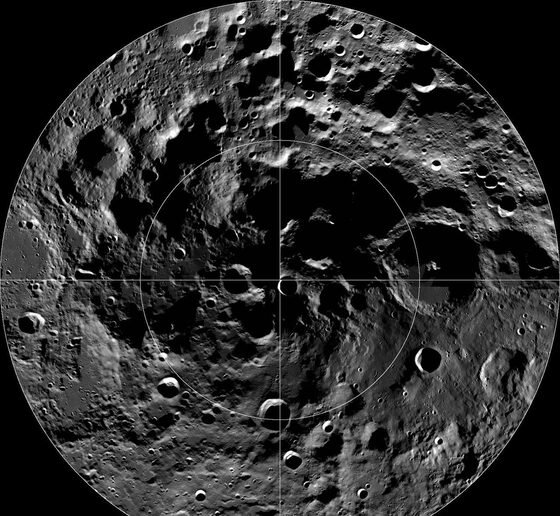
At the south pole the Sun skims along the horizon, so a crater rim several kilometres away decides whether you have power. Four Lights precomputes a 360 degree skyline for every site from NASA's Lunar Reconnaissance Orbiter LOLA elevation data, published by the Planetary Geodesy Data Archive, using 5 m detail near the site and coarser models out to about 650 km. It then checks hourly Sun and Earth positions from JPL Horizons for 2028 and 2029 against that skyline. Comms uses the three 70 m Deep Space Network dishes at Goldstone, Madrid and Canberra.
We checked the horizons against GRASS GIS, the ephemeris against NASA's SPICE toolkit, and one site against published research (Barker et al. 2021).
If you work in GIS, every site, skyline and terrain layer opens in QGIS, so you can check our work in QGIS against your own data. There is also a 3D Moon map built with three.js.
Underneath, it is the same stack we use for our own sites: TypeScript, a Cloudflare Worker with static assets and Workers AI, plus a Python pipeline doing the heavy terrain work. We used Claude Code throughout and wrote up exactly how on the How we built it page.
The weekend
The rules allowed data and tools preparation before the weekend, but no coding. We spent the week before pulling down about 5 GB of elevation models and checking every source, and it paid off: the core was working early on Saturday, so we set ourselves six stretch goals.
We had five of them done when we pitched at the Gold Coast Innovation Hub event at 3:30pm on Sunday, and we took the local Queensland prize for Best Use of Tech. We also won the FirstWave prize, a very nice hamper. After the pitch I finished the sixth stretch goal, and we submitted at 10pm, well before the deadline.
Thanks
Thanks to Joshua Smith, Sharon Hunneybell and the crew at the Gold Coast Innovation Hub for running the event, to our mentors Louise Agnew and Ross Nelson, and to the judges Debby Lo-Dean, Christine Lennon, Clarence Tan and Aaron Thornton. Thanks also to the sponsors: Orbit2Orbit, FirstWave, Media8, who hosted the venue and livestream, and Sonus PR.
Try it
Everything is open. The app is at fourlights.gcsa.space, the project write-up is at gcsa.space, and the code is on GitHub under Apache 2.0. Four Lights is an independent hobby project and is not endorsed by NASA.
We are hoping to make the next round. Either way, it was a good reminder of why we keep turning up to hackathons: one weekend, one hard problem, and a room full of people who want to build something.
Image credits: Earthrise, Apollo 8 (AS08-14-2383), NASA. Lunar south pole, LRO Wide Angle Camera (PIA13523), NASA/GSFC/Arizona State University. Deep Space Station 43, Canberra (PIA23797), NASA/JPL-Caltech. Four Lights screenshot, team Make it So (CC BY 4.0). Sir Patrick Stewart at the Peabody Awards, 2012, Anders Krusberg / Peabody Awards, via Wikimedia Commons (CC BY 2.0).
